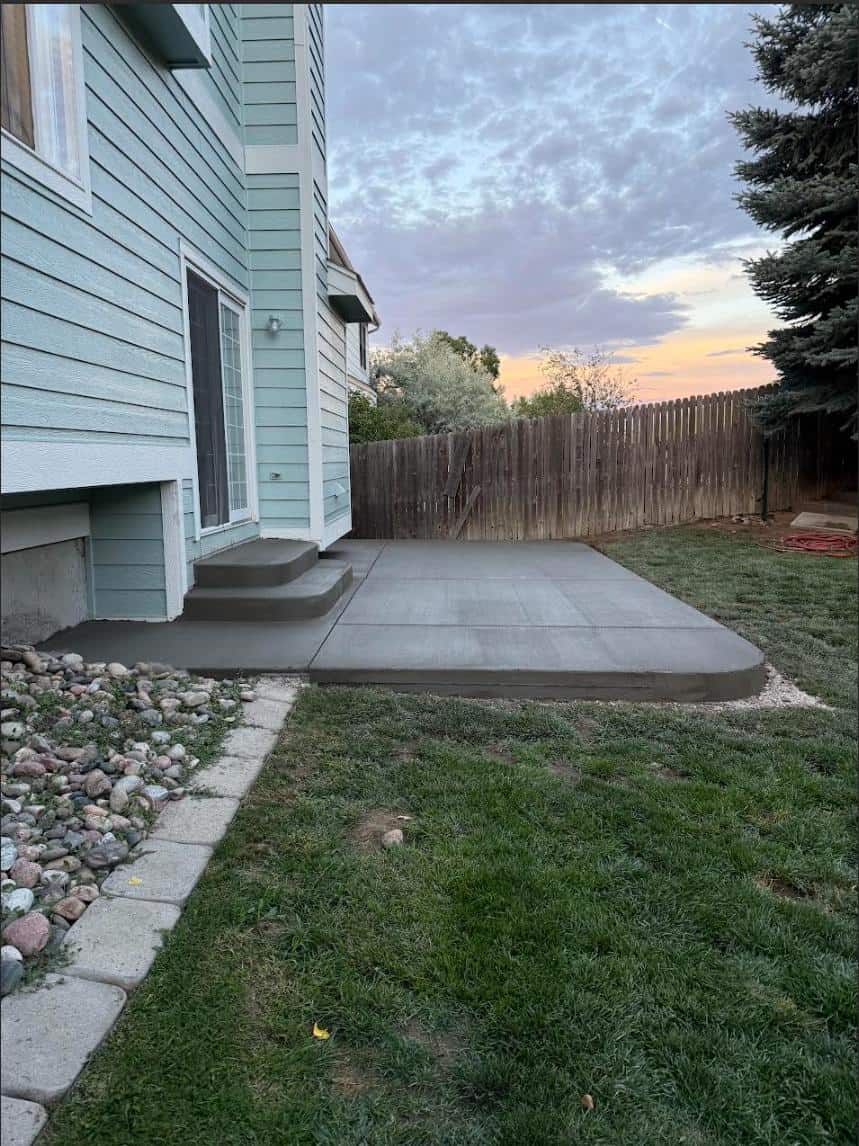
Your Concrete Looks Rough. Is It Actually Done?
We get this call a lot. A homeowner walks out to the patio with their coffee, looks down at a slab that has gone gray, blotchy, and a little crumbly around the edges, and thinks, “Well, I guess this is a tear-out.”
Sometimes it is. But a surprising number of the time, it isn’t. That tired-looking surface might be sitting on a perfectly solid slab that just needs a new face, and a concrete overlay can give it one for a lot less demolition, a lot less mess, and usually a lot less money than starting from scratch.
The tricky part is knowing which situation you are in. An overlay on the wrong slab is a waste of money, and a full replacement on a slab that only needed resurfacing is also a waste of money. So let’s walk through how we tell the difference here in Colorado Springs.
What a Concrete Overlay Actually Is
An overlay is a thin layer of polymer-modified cement, bonded right on top of your existing concrete. Think of it like a new skin. Depending on the product, it can be as thin as a credit card or about half an inch thick, and it can be finished in a bunch of different ways.
You can have it troweled smooth, sprayed with a light texture for better traction, colored with integral pigments or stains, or stamped to look like flagstone, slate, or brick. That last one surprises people. Yes, you can stamp an overlay, and a stamped overlay over an old slab is one of the most popular ways we turn a plain patio into something people ask about at barbecues.
The key thing to understand is that an overlay is a surface fix. It does not strengthen the slab underneath it, and it does not move it, level it, or stop it from doing whatever it was already doing. The overlay is only as good as the concrete it is bonded to.
What Overlays Are Great At Fixing
When the slab underneath is structurally sound, an overlay can solve a lot of cosmetic headaches:
- Stains, discoloration, and that faded, chalky gray look
- Light surface scaling and minor pitting
- Hairline cracks that are stable and not growing
- Outdated or boring finishes you are just tired of looking at
- Rough, worn surfaces that have lost their texture
- Slick spots where you want better traction
If your list of complaints is mostly about how the concrete looks, an overlay is worth a serious conversation. We see this most often on patios, pool decks, walkways, and older driveways that are still solid but have lost their curb appeal.
What Overlays Cannot Fix
This is the part we want to be really straight about, because it is where things go wrong when a contractor says yes to everything.
- Heaved or settled slabs, where one section sits higher than its neighbor
- Wide or moving cracks, especially ones you can fit a coin into
- Deep, widespread spalling where chunks of the surface are breaking away
- Slabs that drain toward your house or hold standing water
- Concrete that was poorly built from the start, with weak mix or no base prep
A crack that is still moving will telegraph right through a new overlay, usually within a season or two. Same goes for a slab that is sinking into soft soil. You can put the prettiest finish in the world on top, but if the foundation underneath is shifting, the overlay will crack right along with it.
The Five Minute Test: Is Your Slab a Good Candidate?
You can do a rough check yourself before anyone comes out. Walk your slab and look for these things.
First, check the cracks. Hairline cracks that have not changed in a couple of years are usually fine. Cracks that are widening, offset from one side to the other, or wide enough to catch your fingernail are a warning sign.
Second, check for movement. Do you see sections that sit higher or lower than the ones next to them? Is there a gap between the slab and your house or garage? Those point to a base or soil problem, not a surface problem.
Third, tap the surface with a hammer or the back of a heavy screwdriver. A solid ring is a good sign. A hollow, dull sound in a spot means that area may be delaminating from the slab, and that needs to be dealt with before anything gets bonded on top.
Fourth, look at the drainage. After a rain or a hard sprinkler run, does water sit in low spots? An overlay can sometimes correct minor surface dips, but it will not fix a slab that was poured with the wrong slope.
If you passed all four, you are probably a good candidate. If you failed a couple, don’t panic. That is exactly what a free, honest look from a pro is for.
Why Colorado Springs Adds a Wrinkle
Here is where our climate gets a vote. We live at elevation, with strong UV, big temperature swings, and a freeze-thaw cycle that puts concrete through the wringer every winter. If you want the full story on that, we wrote about it in why Colorado’s freeze-thaw cycle wrecks concrete.
For overlays, it means a few things matter more than they would in a mild climate. The surface has to be cleaned and prepped properly so the bond holds through repeated expansion and contraction. The overlay product needs to be one designed for exterior freeze-thaw exposure, not a bargain bag that works fine in a garage in Arizona. And the finished surface needs a good sealer, with regular resealing, to keep water out of the layer and the slab beneath it.
Cut corners on any of those three and an overlay can start peeling or flaking after a hard winter or two. Do them right and it holds up beautifully.
What the Process Looks Like
Overlays are faster and cleaner than a full replacement, which is part of the appeal. Here is the usual flow.
We start by inspecting the slab and repairing anything that needs it. That means filling stable cracks, patching small damaged areas, and making sure we are building on something solid.
Next comes surface prep. The old concrete gets cleaned and mechanically profiled, usually with grinding or shot blasting, so the new layer has something to grab. This step is the heart of the whole job. Skipped prep is the number one reason overlays fail.
Then the overlay goes down. Depending on the system, it is troweled, sprayed, or squeegeed on, then stamped, textured, or colored the way you picked. Color can go in the mix or be added with stains and dyes afterward.
Finally, we seal it. Sealer gives the finish depth, protects the color, and keeps moisture out. Most projects are walkable within a day and ready for normal use in a few days, which beats the weeks of dust, hauling, and forms that come with a tear-out.
Overlay vs. Replacement: Side by Side
The short version is this. An overlay usually costs less, finishes faster, and creates far less mess and disruption, but it only works on sound concrete and is not a structural fix. A replacement costs more and takes longer, but it solves everything, including slope, thickness, and base problems, and gives you a fresh 25 to 30 year runway.
If your slab is solid and you mostly want a new look, overlay wins on value almost every time. If your slab is moving, sinking, or crumbling, replacement wins, and trying to save money with an overlay just means paying twice.
How Long Does an Overlay Last?
Honest answer: it depends on the prep, the product, and the care. A well-installed overlay on sound concrete, sealed on schedule, can look great for many years. Like any decorative surface, it needs resealing every couple of years to stay protected, and high traffic areas or spots that get a lot of de-icer may need a little more attention.
What we will not do is promise it lasts forever or that it behaves like a brand new slab. It is a very good way to extend the life and improve the look of concrete that is already in good shape. That is plenty.
When Replacement Is the Smarter Move
Sometimes the kindest thing we can tell you is to skip the overlay. If your driveway has widespread spalling, sections that have heaved or sunk, or cracks that keep coming back, you are looking at a driveway replacement, not a cosmetic fix. We covered the warning signs in 5 signs your concrete driveway needs to be replaced, and it is worth a read if you are on the fence.
The same logic applies to patios. If the slab is in good shape, a stamped or textured overlay can transform it. If it has a drainage problem or serious cracking, you are better off starting fresh with a new stamped concrete patio that is built to last from day one.
And if what you really have is a few damaged spots on an otherwise decent slab, targeted concrete repair and restoration might be all you need.
The Bottom Line
A tired-looking slab is not automatically a dead slab. If the concrete underneath is solid, level, and draining properly, an overlay can give you a brand new look, in nearly any color or pattern, for less money and with a lot less disruption than a tear-out. If it is not, replacement is the honest answer, and no amount of pretty finish will change that.
The only way to know for sure is to have someone who works with concrete every day take a look at it in person. That is a five minute conversation that can save you thousands.
Let’s Take a Look at Your Concrete
Whether you are curious about a decorative finish for a patio you already have, or you suspect your driveway is past the point of no return, we will give you a straight answer about which direction makes sense. No pressure and no upsell, just an honest look.
Reach out and let’s figure out the right move for your slab.